

(Spoiler Alert)
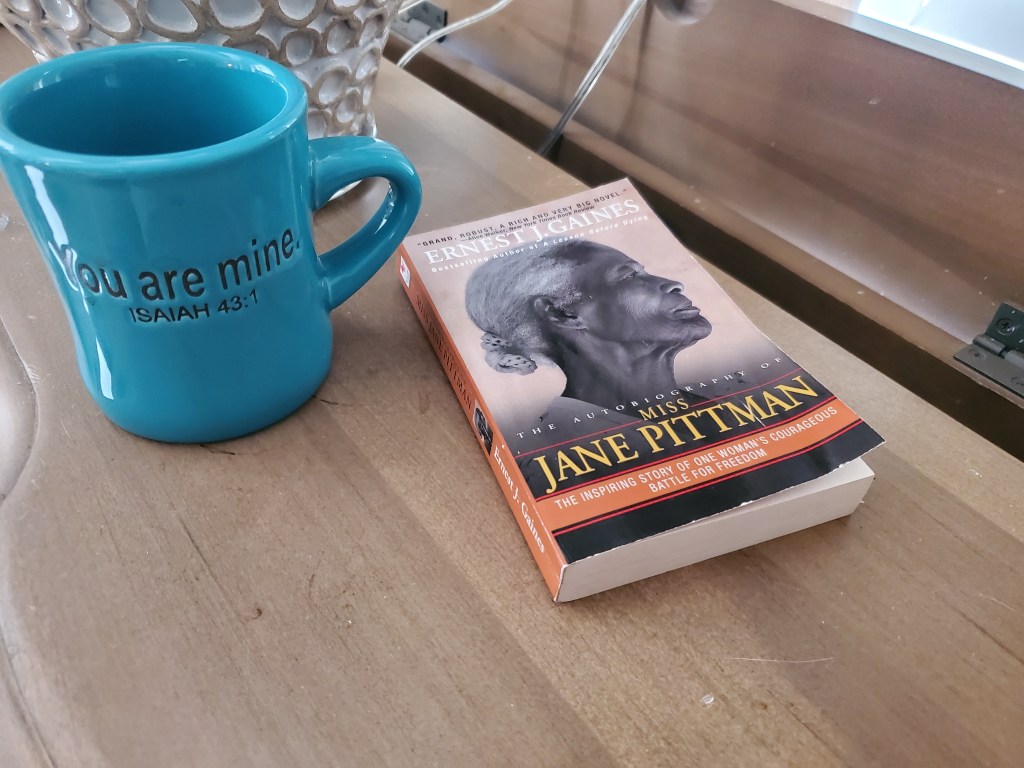
My good book pick for the month is The autobiography of Miss Jane Pittman by Ernest Gaines. Before I dive into my reflections and thoughts about the book, I would like to define what I consider a good book. A good book first and foremost is thought provoking because it reveals something true of reality, a truth to ponder over and to chew on that even after the book is read, it lingers. In good books, characters come alive because they become a reflection of the human condition and lastly good books are those that bring me closer to God.
The book by Ernest Gaines is about a fictional character, Miss Jane Pittman a black woman, who tells her story from the time she was a young girl just recently emancipated from slavery up until her late adulthood. During her recollections, she narrates her life against the backdrop of the changing cultural and political landscape, from the emancipation, reconstruction and up to the civil rights movement. If you would like to know more of the premise of the book I suggest visiting its Amazon website.
The book had moments I thought were gripping, some moments were repulsive in its cruelty but then there were moments where one becomes hopeful in the goodness of humanity. When I first started reading the book, I was guarded and cautious. I was fearful that this book will be another revisionist take on American history. I was afraid the book will be another propaganda portraying white people as an evil race and that America is evil due to its history of slavery. My fear was thankfully unfounded. This book is not “woke” it is instead a portrayal of a life, that in the midst of so much suffering showed resiliency and upheld the dignity of the person.
The time I finished the book is about the same time I read Acts Chapter 11 on the Hallow app with Scott Hahn’s Acts Bible study. I thought it was both fitting and timely as in this chapter, Cornelius, a Gentile, became a member of the Church. It was no ordinary feat for Peter to enter into a Gentile’s house and eat with him. During this time of history, Jews, under the Mosaic law, are not allowed to eat certain foods and deemed certain people as unclean like the Gentiles. God orders Peter, through a vision, that he can eat animals even those he thought unclean and that he is to visit a Gentile(Cornelius). Cornelius and his household get baptized after Peter proclaims the Good News. They receive the Holy Spirit, the same Holy Spirit the apostles received at Pentecost. It is clear that God makes no ethnic or racial distinction with his offer of salvation. It is for everyone because all are sinners. Through baptism, we become united as part of the mystical body, the Church. As I compare and contrast Mr. Gaines fictional work and this Chapter, I felt so grateful for God’s immense love who wills the good of all humanity. Mr Gaines in his work, showed how the capacity for evil knows no racial bounds. It was seen in the Secessionist soldiers who tortured and murdered black people out of whim but also in Albert Cluveaux , a Cajun man, who assassinates Ned, Miss Jane’s adopted son. Along with this capacity for evil, there is also the capacity for good exemplified in Joe Pittman, an admirable and loving black man who is Jane’ s lover/partner and Jules Raynard a white man who is instrumental in saving Mary Agnes, a Creole teacher.
Yes we are all sinners but that is not the end of the story, we are also worth saving because we all have dignity. This is one of the themes found in this book. Miss Jane is a character who does not act like a victim and does not see herself one despite her past as a slave. Her life exuded a woman who took personal responsibility, a woman who knows and understands her dignity. What is this dignity? According to the Catechism of the Catholic Church
“356 Of all visible creatures only man is “able to know and love his creator”.219 He is “the only creature on earth that God has willed for its own sake”,220 and he alone is called to share, by knowledge and love, in God’s own life. It was for this end that he was created, and this is the fundamental reason for his dignity:What made you establish man in so great a dignity? Certainly the incalculable love by which you have looked on your creature in yourself! You are taken with love for her; for by love indeed you created her, by love you have given her a being capable of tasting your eternal Good.221
357 Being in the image of God the human individual possesses the dignity of a person, who is not just something, but someone. He is capable of self-knowledge, of self-possession and of freely giving himself and entering into communion with other persons. And he is called by grace to a covenant with his Creator, to offer him a response of faith and love that no other creature can give in his stead.
1700 The dignity of the human person is rooted in his creation in the image and likeness of God”
What a beautiful explanation of human dignity. This dignity is universal and intrinsic. This dignity is what Miss Jane Pittman’s life embodied. She knew it at a young age. She knew it when she tells her former Mistress that her name is no longer Ticey, but Jane and she says it with her head held high. She also saw the dignity of others, that is why she was able to care for Ned when she was only 10 years old. Ned, who was not so much younger than her, lost his mother in the hands of Secessionist soldiers. Instead of leaving him all alone, she takes care of him and becomes his new mother. She knew her dignity when she assures a 17 year old Ned, who was trying to persuade her to leave the plantation with him, that she won’t be a dog working under a white man. She assures him “I wont eat crumbs, Ned, and I won’t eat off the floor.” She showed dignity in the manner she treats her employers. She continues to work hard under Robert Samson, the white plantation owner, but talks to them not as someone less but someone also deserving of respect.
As I read the book, Miss Jane did not feel like someone who is limited by her circumstances, or imprisoned by her suffering. She had a form of freedom that is different from what people usually think when they hear the word. In Jacques Philippe’s book Interior freedom, he states
“There is a paradoxical law of human life here: one cannot become truly free unless one accepts not always being free. To achieve true interior freedom we must train ourselves to accept, peacefully and willingly plenty of things that seem to contradict our freedom.This means consenting to our personal limitations, our weaknesses, our powerlessness this or that situation that life imposes on us and so on.”
Miss Jane’s acceptance of her situation and limitations is, what I believe, the source of her wisdom. It is also the reason why she does not despair even when she finds out she is barren or experiences the death of those most dear to her. It is also the reason why she does not hate Albert for killing Ned or holding a grudge on white people for the racism she endures.
When we understand we have dignity, we then can have the courage to do what is right. I think the best example of this moral courage is close to the end of the book when Miss Jane, at this point, is 100+ years old. We are introduced to Jimmy, a kind of hero figure, who wants to fight for the rights of the black people. Martin Luther King Jr is his inspiration and he wants to spread the message of equality in his hometown. He asks Miss Jane for help by being part of a protest and with her presence she may persuade others to overcome their fears and join them. Miss Jane accepts and surrenders the outcome to the Lord. The day when their protest was to happen, Jimmy is killed and Miss Jane, along with a few other townspeople brave enough to come, continue their trip to attend the protest.
Ernest Gaines did an excellent job in showing the other side of this courage. Robert Samson, warned them against participating in political protests. The townspeople feared the repercussions of speaking up and participating in the movement because it would lead to them being jobless and homeless. They did not want to support Jimmy and some even thought he was causing division. As I read this part, I could not help but feel disappointed and ashamed by their cowardice but then I remember an event that happened recently that gave me a different perspective.
Two of my friends and I decided to pray right outside a clinic that conducted abortion services as part of the 40 days for Life Vigil. This is the first time I have ever done this and did not know what to expect. That day it was raining. We stood next to each other with our umbrellas opened and started praying the rosary. As we were praying, fear took hold of me. This fear made me cower and avoid any eye contact with people coming in and out of the clinic. I was afraid of confrontation, of someone coming up to us to hurt or hurl insults at us. I stopped praying to share with my friends what I was feeling and suddenly my fears were alleviated. I remember telling God in my thoughts how cowardly I am and that I need Him to make me brave to do the right thing. Since that episode I had a newfound respect for people who are doing what is right in the face of persecution or death. I say this to show that we can tell ourselves we would have done better or differently if put in the same situation, that we would have the courage if we have lived in the past but truthfully we would not be able to understand their fears unless we ourselves are put in a similar situation.
The ending of the book seemed prematurely cut short but I thought it was appropriate. Robert Samson stops Miss Jane from attending the protest while Miss Jane firmly resolves to go. Jimmy’s death gives the other townspeople a newfound strength to participate in the protest not only to keep Jimmy’s memory alive but to show that they understood what Jimmy was fighting for. Robert and Miss Jane “looked at each other a long time, then (she) went by him”. The ending to me is a triumphant call to action. It is as if Mr. Gaines is telling his people, what are you waiting for? Go and show that your life is as sacred as theirs.

 Traveling The Little Way